

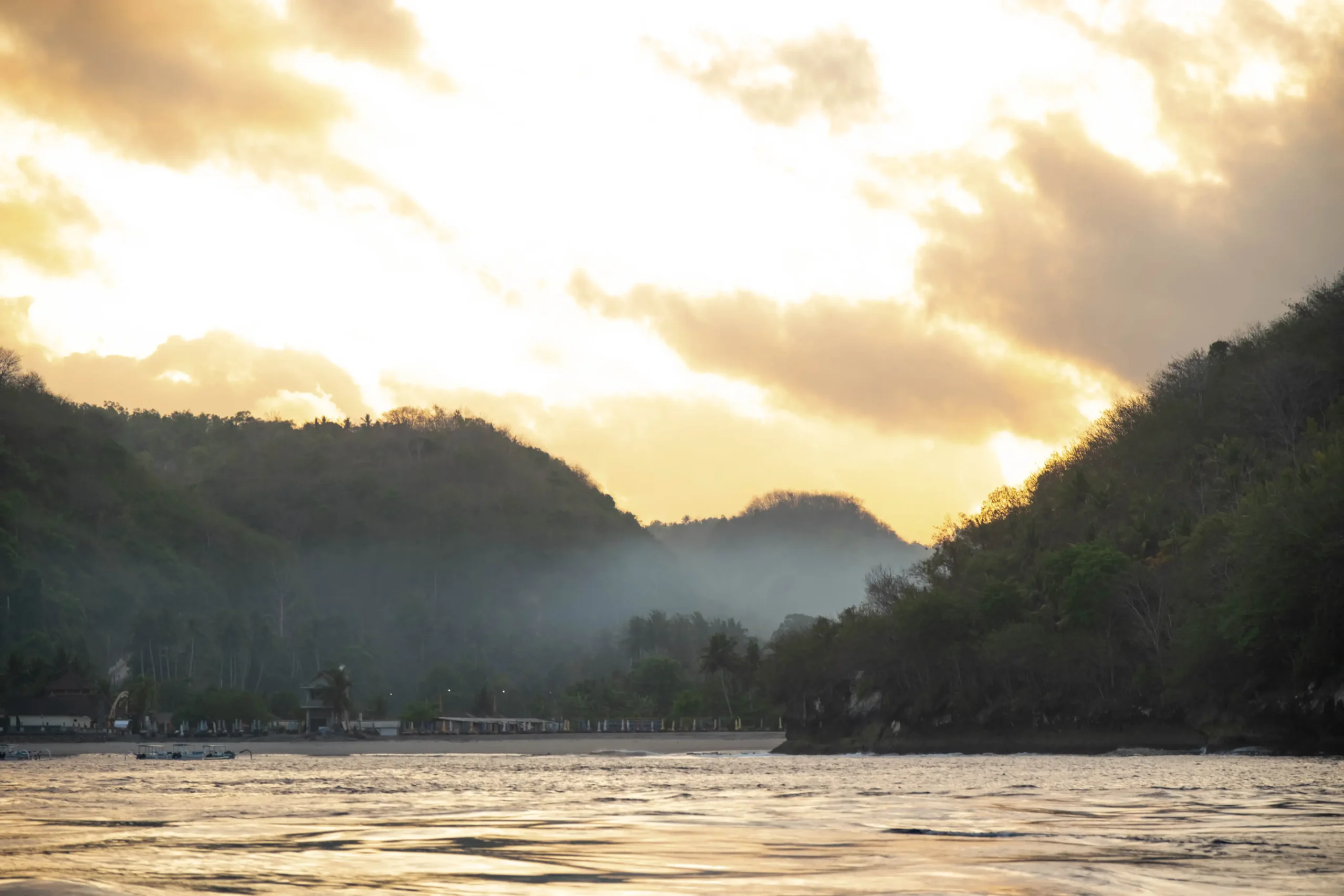
Most people arrive in Nusa Penida with a list: Kelingking, Angel’s Billabong, Broken Beach, Crystal Bay. The list is reasonable, and the island rewards it. But after a few days, many visitors find that the moments they remember most are not the famous viewpoints. They are the stretch of road past dry-season fields, the warung where the owner asks where you are from, and the sunset that arrives slowly and then all at once.
This Nusa Penida travel guide covers how to get there, how to get around, what to see, when to go, and where to stay for a trip that feels unhurried.
How to Get to Nusa Penida
Nusa Penida sits southeast of Bali, and the crossing is by fast boat from Sanur or Padang Bai. Crossing times vary by operator and sea conditions, but the trip is usually under an hour. Boats do not run as frequently as a city ferry, so check the schedule before you plan your day, and aim to arrive early so you have time on the road and a buffer if the sea is rougher than expected.
If you would rather not coordinate the crossing yourself, seamless Nusa Penida package takes care of the boat, the driver, and your hotel, so you can step off the boat and start the day on the island.
Guests who prefer to arrange their own transport can still book a boat directly, but it helps to confirm the return crossing before you start exploring.
Getting Around the Island
Map distances on Nusa Penida look small, but the roads are steep, winding, and often rough. A journey that appears short can take much longer than expected, so plan for fewer stops than you think you can fit in.
Many visitors hire a driver for the day, which lets them focus on the view rather than the next bend. Those who ride a scooter tend to go slowly, stop often, and treat the ride as part of the day. Wear a helmet and sturdy footwear with good grip, and carry cash in small rupiah notes, since many sites charge small entry or parking fees.
Things to Do in Nusa Penida
Kelingking Beach. The island’s most photographed cliff drops steeply into a curved bay. The viewpoints are busy around midday, so early morning gives you a calmer look at the shape of the coastline. The path down is steep, so take it slowly.
Angel’s Billabong and Broken Beach. These sit on the west coast. Angel’s Billabong is a tidal lagoon at the edge of the cliffs, and Broken Beach is a rock arch that opens onto a sheltered cove. Check tide times before you visit, since the lagoon looks very different at different levels.
Crystal Bay. Sheltered water, a more relaxed mood, and a good place to slow down after the cliffs. This is a favourite for snorkeling and for simply sitting by the water with a drink.
Diamond Beach and Atuh. On the east coast, the cliffs are rugged and the water is clear. Access involves stairs and uneven paths, so wear shoes you can walk in.
Goa Giri Putri. A Balinese Hindu temple set inside a limestone cave. Visitors enter through a narrow opening, and the cave opens into a large chamber. Dress respectfully and follow the guidance of local staff.
Manta rays and the underwater world. Nusa Penida is known for snorkeling and diving, especially for manta rays. Conditions can be demanding, so choose operators who prioritize safety and know the currents well. Even for non-divers, a morning on the water, watching the cliffs pass by, is one of the simplest pleasures the island offers.
When to Visit
The dry season, roughly April to October, is generally considered the best time to visit. Seas tend to be calmer, boat crossings are easier, and visibility for snorkeling and diving is usually better.
The island also observes Nyepi Laut, a day when sea and boat traffic is restricted. Because boats are not running, the water around the island feels unusually still. Check the official dates before you plan around them, and note that the restriction applies to sea and boat traffic, not to movement on land.
Practical Tips
- Start early to beat the crowds at the main viewpoints.
- Carry cash, water, sun protection and a light layer for the boat.
- Pack seasickness tablets if you are prone to motion sickness.
- Leave time between sites. Travel times are longer than they look on a map.
- Confirm the return boat before you start your day.
Where to Stay in Nusa Penida

After a day on the roads, many travelers want a quiet base that feels like part of the island rather than a place to pass through. Adiwana Warnakali is one such option. The resort sits on the cliffs of Nusa Penida, with its rooms and villas arranged to follow the natural shape of the land and face the sea. From many of them, the view stretches toward Mount Agung and across to Nusa Ceningan.
Mornings here are simple: coffee with the ocean in front of you, a slow breakfast, and time to plan the day or do nothing at all. The pool and sun deck offer a place to rest as the light moves across the water, and the restaurant is a good spot for dinner as the sky changes colour. Tejas Spa Warnakali offers treatments for the end of a long day on the roads.
For couples, honeymooners, and travelers who prefer a slower kind of holiday, the appeal is less about one headline view and more about the rhythm of the stay: the sea in the morning, the island during the day, and a calm place to return to in the evening.
Nusa Penida will set its own pace whether you plan for it or not. Staying somewhere that lets you move with it is part of the experience.


